Make a Mixing Map Before Expanding a Watercolour Box
A paint box with many colours can make a small sketching kit feel complete while leaving you unsure what its contents do together. Begin with a limited, clearly identified selection and make a mixing map. The exercise shows actual gaps in your palette before another row of pans enters the bag.
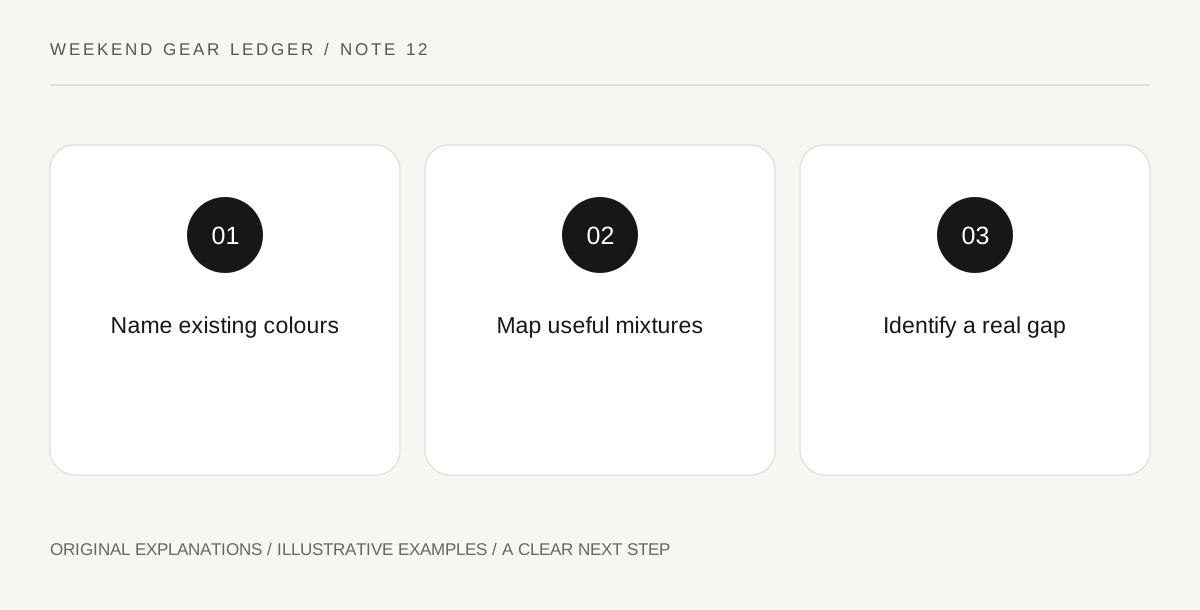
Original explanatory diagram. Read the full method and limitations below.
Choose a bounded mixing exercise
Winsor and Newton describes three- and six-colour primary mixing systems within its ranges. Use that as evidence that a limited selection can be a deliberate approach, rather than a promise that every red, yellow and blue behaves identically. For your exercise, identify the colours you already own by their maker’s names and pigment information where provided. Follow product handling guidance and keep art materials separate from food.
Give each mixture a location
On suitable scrap watercolour paper, label a small grid with the chosen colour names. Make individual colour samples first, then pairs, leaving enough space to write what was combined. This is a personal reference sheet rather than a standardized laboratory test. Keep the brush, water and paper consistent enough that you can recognize your process, and avoid filling every empty area merely to make the sheet look finished.
Notice usable variation within one mixture
A mixture can be explored at different dilutions without adding another purchased colour. Compare a pale wash and a more concentrated patch made according to the paint’s instructions. Let the paper dry before making a final note about its appearance. Record descriptions such as cool muted green or warm grey rather than claiming that your improvised amounts are universal recipes another brand will reproduce exactly.
Write a specific expansion question
After a few sketches, identify a repeated need that the existing map does not answer. Perhaps you want a particular vivid mixture that your present choices do not produce conveniently. Ask about one relevant colour rather than upgrading the whole box. Include the space needed for mixing, brush access and cleanup in the kit plan. Empty compartments can remain empty while you learn the materials already in them.
Illustrative worked example
Illustrative example: Noor has six small pans but repeatedly buys extra greens for park sketches. A labelled mixing sheet shows three useful greens from existing pairs, plus a muted neutral for distant shapes. Noor carries that sheet with the original box for the next outing and postpones an additional pan until a specific missing result is identified. This is an invented learning exercise, not a comparison of paint brands or pigment performance.
Questions that come up
Will three primary colours make every colour I imagine?
Do not treat a limited palette as a guarantee of every possible result. Actual pigments have different mixing behaviour. The map helps you learn the particular materials you own and decide what, if anything, to add.
Must a sketching box be full?
No. A smaller understood selection can be easier to use than a full box of unexplored pans. Leave space for mixing and handling, and let your own completed sketches inform later purchases.
References and scope
These sources support the factual background. Examples and exercises are original illustrative teaching material. References do not imply endorsement.
- Winsor and Newton: watercolour primary colours — A limited primary-colour palette can support mixing practice; manufacturer examples are not universal rankings.