A Card Viewfinder and Four Small Sketches Before More Art Gear
An outdoor scene can feel too large to draw even when your equipment is simple. A card window helps you decide what belongs inside a sketch. Pair it with a few small thumbnail spaces and a pencil, and you can explore composition without assembling a large painting setup or buying a specialized drawing device.
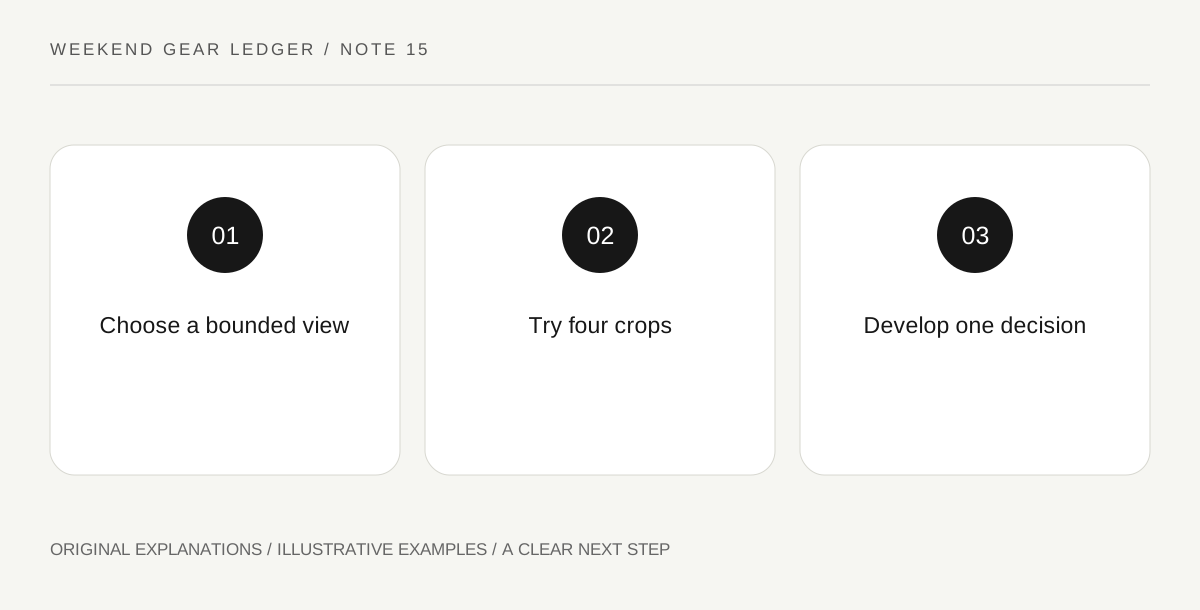
Original explanatory diagram. Read the full method and limitations below.
Treat the frame as a decision tool
The Royal Drawing School includes a viewfinder and thumbnails in its drawing teaching resources. For an adult beginner exercise, use an existing simple card frame or make one with ordinary safe craft handling before the outing. It does not measure artistic quality. It provides a visible boundary so you can choose a manageable portion of a scene while remaining at a permitted, stationary viewing place.
Keep the page shape in mind
Draw a few small rectangles on ordinary practice paper. If your card window has a very different proportion, note that the crop will change when transferred. Choose one proportion for this exercise rather than buying adjustable equipment immediately. Hold the frame comfortably, find a simple arrangement of large shapes and lower it when needed. Avoid blocking paths or focusing so intently that you lose awareness of the place around you.
Vary the crop instead of the shopping list
Make four small studies from the same general view, changing the amount of foreground, the main shape’s position or the included edges. Use a few lines or broad value marks rather than trying to finish every leaf. Label what changed between studies. The useful comparison concerns framing decisions; changing pencils, paper and location for every sketch would obscure that particular question and require more equipment to manage.
Choose one reason to develop a study
Compare the thumbnails and name a specific reason for preferring one: a clearer silhouette, a less crowded edge or a stronger relationship between two shapes. A different person may choose differently. Keep the selected thumbnail with any later drawing so you remember the original decision. Only add equipment when a particular task requires it, rather than using a new supply purchase as the default response to uncertainty.
Illustrative worked example
Illustrative example: Ellis sits at an authorized park sketching spot with a pencil, paper and a prepared card window. Four thumbnail crops show the same pavilion with different amounts of surrounding path. One crop removes an awkward half-visible sign at the edge and gives the building more space. Ellis develops that arrangement on the next page. The improvement described is an invented compositional choice, not a measured effect of a product.
Questions that come up
Do I need an adjustable commercial viewfinder?
A simple prepared card window is enough to explore this bounded exercise. Commercial features may be useful for other tasks, but first identify which limitation of the simple version you actually encounter.
Must every thumbnail become a finished drawing?
No. A thumbnail can do its job by helping you reject a crowded crop or remember an arrangement. Keep the useful decision rather than treating every small practice sketch as an unfinished obligation.
References and scope
These sources support the factual background. Examples and exercises are original illustrative teaching material. References do not imply endorsement.
- Royal Drawing School: thumbnailing — Viewfinders and thumbnail studies as drawing-learning tools; the article supplies its own adult exercise.