Glasses and Eyecups: Check the Whole Binocular View
A binocular can have an attractive specification sheet yet give you an awkward view through your everyday glasses. Before comparing accessories, examine whether you can see the circular field comfortably. This is a short fitting exercise for an ordinary, stationary target, with the actual model instructions beside you.
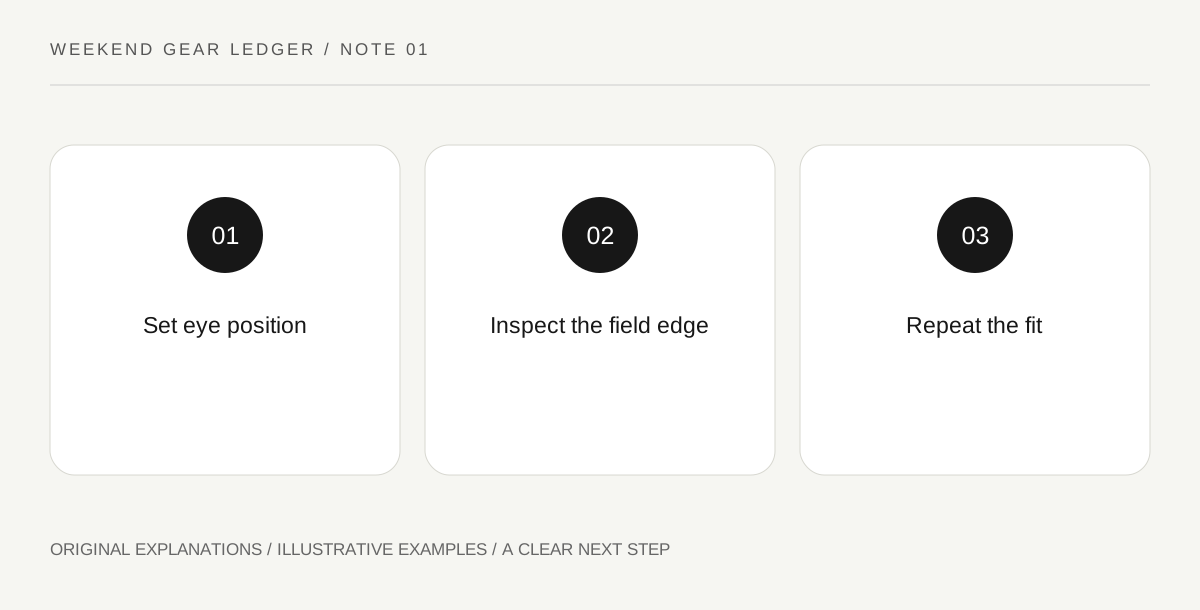
Original explanatory diagram. Read the full method and limitations below.
Separate eye position from sharpness
Eye relief concerns the distance from the eyepiece at which the field is visible; focus concerns sharpness. Audubon explains why glasses and adjustable eyecups matter to that relationship. Turning the focus wheel cannot solve every dark crescent or clipped edge. Start by identifying the eyecup adjustment the manufacturer provides, and use only its intended positions. Do not force a control that appears stuck or assume all eyecups twist.
Choose a target that stays put
Use a permitted viewing position and a stationary sign or architectural detail away from the Sun. Keep your usual glasses on if that is how you intend to observe. Set the barrel spacing so the view combines comfortably, following the manual. Notice the field boundary before judging tiny detail. Stop if viewing is uncomfortable; an equipment comparison is not a reason to persist through eye strain.
Describe the problem precisely
Record whether the edge disappears when you move slightly, whether one side behaves differently, and which eyecup setting you used. Those observations help a shop assistant distinguish fitting from focusing. A statement such as unable to see both edges with my glasses is more useful than poor optics. If you share binoculars, each person should make an individual assessment rather than inherit someone else’s successful adjustment.
Compare complete use rather than one glance
After finding a comfortable position, lower the binoculars and bring them up again a few times while remaining stationary. The question is whether the fit can be found repeatedly without pressing hard against your glasses. Compare the handling burden alongside the view: reaching the wheel, holding the barrels and using the supplied carrying arrangement. A higher price does not answer any of those personal questions.
Illustrative worked example
Illustrative example: Jo compares two demonstration binoculars while wearing the same glasses. With the first, the central lettering is sharp but the circular boundary keeps disappearing. With the second, an instructed eyecup position gives a repeatable full view. Jo records those observations and the model names rather than assigning either product a universal quality score. The first unit remains a poor fit for this particular comparison.
Questions that come up
Should I remove my glasses automatically?
No. Decide how you will actually observe and discuss individual vision needs with an appropriate professional when necessary. This exercise compares equipment fit; it does not determine a prescription or diagnose why an image looks different.
Does advertised eye relief settle the choice?
It helps narrow candidates, but the actual combination of glasses, eyecups and face position still needs evaluation. Keep a fit observation alongside the specification instead of treating one number as a guaranteed experience.
References and scope
These sources support the factual background. Examples and exercises are original illustrative teaching material. References do not imply endorsement.
- Audubon: choosing binoculars — Eye relief, eyecups and glasses; historical educational guidance, not current product rankings.