A Planisphere Purchase Starts with Latitude and Readable Labels
A rotating sky chart is a compact piece of hobby equipment, but choosing one by artwork alone can leave you with the wrong view of the sky. Read its intended latitude, date and time conventions before considering size or waterproof finishes. Practise indoors first, where the labels are easy to inspect.
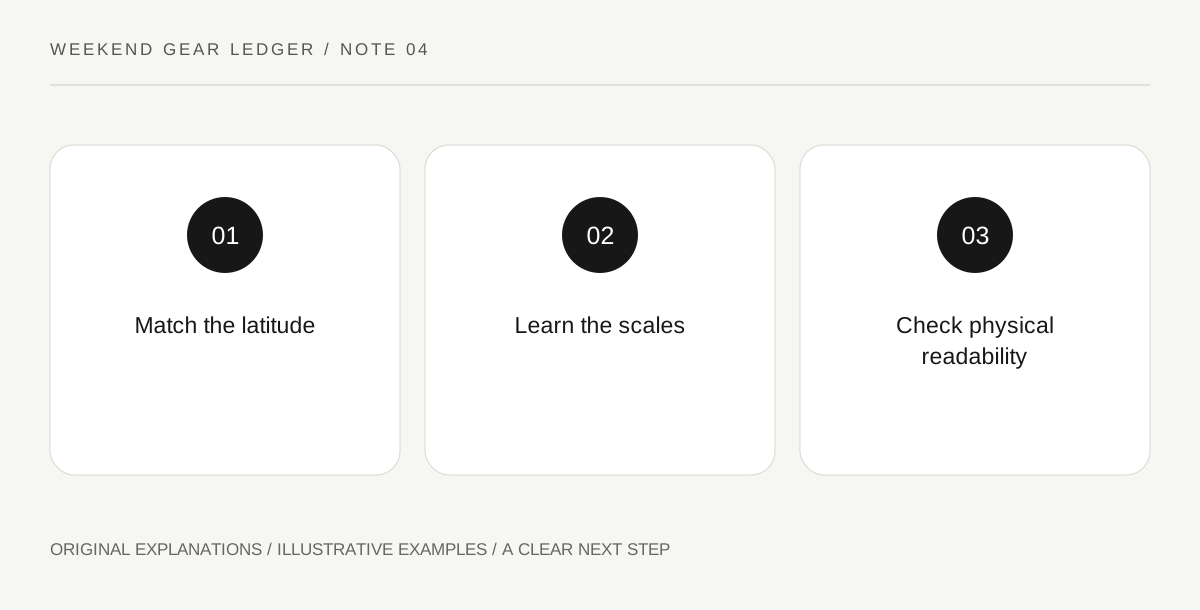
Original explanatory diagram. Read the full method and limitations below.
Check the geographic fit
NASA’s planisphere explanation notes that the chart must suit the observer’s latitude. Find that specification explicitly rather than assuming any chart sold in your country is appropriate everywhere. Record your intended observing region beside the product’s coverage. If the coverage is unclear, ask the maker. A decorative star wheel without sufficient instructions should not be your only way of planning an unfamiliar night outing.
Learn what the rotating layers represent
Inspect the date scale, time scale, viewing window and direction labels. Rotate only as the instructions describe, then explain which pair of labels you aligned. Different products may handle time conventions differently, so read their instructions about local clock time and seasonal changes. The goal is to understand the tool’s representation. It is not a promise that every marked object will be visible from every location.
Distinguish a star pattern from an event calendar
A reusable chart is useful for learning broad star patterns. Current planet positions, transient events and local visibility require appropriate current information rather than inference from permanent printing. Do not buy an elaborate wheel expecting it to replace every other sky resource. Keep the equipment question specific: can you identify the intended sky region and read the labels using the instructions supplied?
Choose a manageable physical format
Compare the chart size with how you intend to hold and store it. Small print may be awkward when you are also managing a light, gloves or a notebook. Inspect whether the rotating layers move without tearing and whether any cover obscures the scales. Plan a permitted, accessible observing place and a simple return journey separately; purchasing a chart does not establish safe access after dark.
Illustrative worked example
Illustrative example: Lina finds two inexpensive star wheels. One states a latitude range appropriate to her home area and explains its time scale; the other offers a dramatic illustration but no clear geographic specification. She selects the first for a supervised beginner evening and rehearses setting an invented practice time indoors. She still checks the event organizer’s current meeting details rather than using the chart as an arrival guide.
Questions that come up
Will a planisphere show every visible planet?
Do not assume that. Check what the specific chart includes and use a current authoritative sky resource for changing positions. A permanent star pattern and a time-sensitive prediction are different information products.
Should I buy the smallest version?
Only if you can read and handle it comfortably. Try the labels at a realistic viewing distance first. A slightly larger chart that you can interpret may be more useful than a pocket wheel that stays unreadable.
References and scope
These sources support the factual background. Examples and exercises are original illustrative teaching material. References do not imply endorsement.
- NASA: Views From the Passenger Seat — Planisphere latitude and rotating sky representation; no historical ephemeris is recommended.