Test a Bird Guide by Using One Complete Species Page
A field guide’s attractive cover does not tell you how easy it is to consult outdoors. Before buying a large volume or downloading several packs, try one complete lookup. Examine the route from an uncertain observation to the picture, text and range key, rather than counting the number of birds advertised.
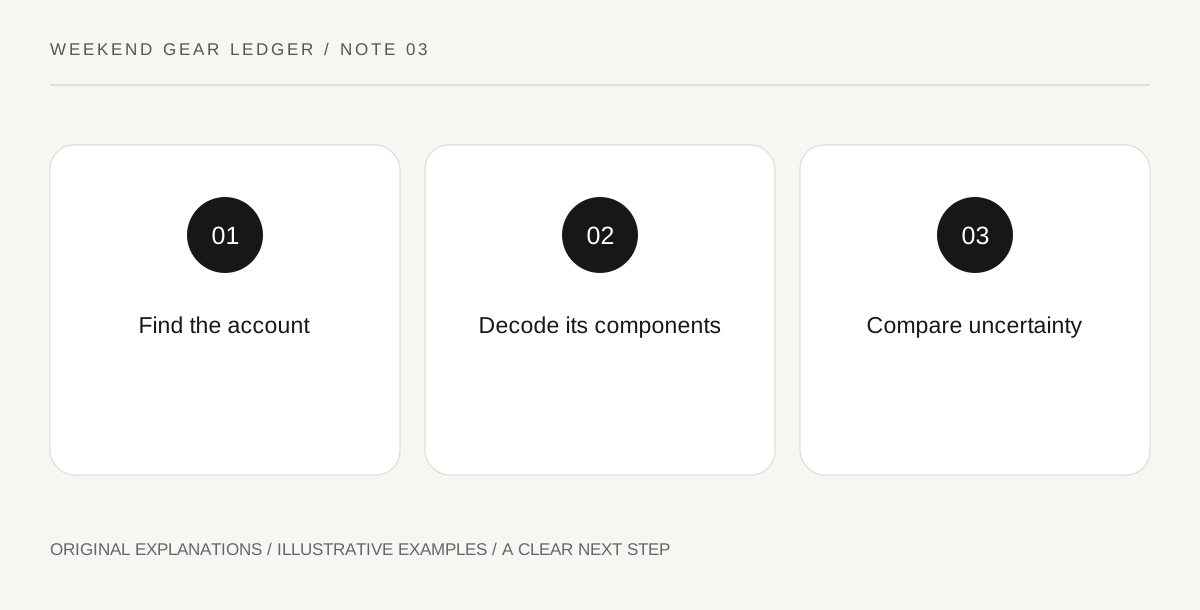
Original explanatory diagram. Read the full method and limitations below.
Start with the index you will actually use
Cornell’s field-guide reference describes species accounts, indexes and grouped organization. For a buying exercise, select a familiar bird name and find its account without assistance. Notice whether the index uses the first word, main noun or both. If you are new to bird groups, a useful index may matter more immediately than memorizing the arrangement of every family in a thick book.
Read beyond the largest picture
Compare the picture with the account’s written field marks, habitat information and any alternative appearances. Cornell notes that plumage can vary with age, sex or season. Your task is to see how the guide communicates variation, not to memorize one ideal illustration. Check whether labels remain legible in the size you would carry. A beautiful page on a large screen can become cramped in a pocket edition.
Decode the map before relying on it
Locate the map legend and explain its colours in your own words. A range depiction is contextual information, not proof that a particular bird was present at your location. Record the region the guide covers and the edition date. For a digital guide, examine what content will be available with your intended connection; do not assume a successful home lookup proves the same page will open offline.
Make a two-candidate practice card
Write an invented observation with only visible features, then compare two plausible accounts without forcing a final name. Leave space for missing evidence such as shape or behaviour. This reveals whether the guide helps you compare uncertainty or merely presents appealing portraits. Avoid using recorded calls to attract wildlife for an equipment demonstration. Quiet observation and honest notes are enough to assess the information design.
Illustrative worked example
Illustrative example: An adult learner tries a borrowed guide using a familiar backyard bird. The main picture is clear, but the learner needs the index twice to relocate the account. A paper tab at the family section solves that navigation problem during the trial. They choose to borrow it again before buying a smaller edition whose map key they have not yet inspected. No identification success rate is claimed.
Questions that come up
Is a larger species count automatically more useful?
No. It may include regions you will not visit while making a portable guide larger. Assess coverage, navigation and legibility for your own outing rather than treating the biggest number as a ranking.
Can a map confirm an identification?
A map can inform plausibility, but the observation still needs supporting features. Keep uncertain sightings uncertain and consult current authoritative bird information when older editions use names or classifications that have since changed.
References and scope
These sources support the factual background. Examples and exercises are original illustrative teaching material. References do not imply endorsement.
- Cornell Lab: how to use a field guide — Species-account components, range maps, indexing and plumage variation; older bird taxonomy is not used.