A Cleanup Kit Needs a Stop-and-Report Routine for Unfamiliar Debris
Volunteer equipment has limits. A grabber, gloves and an enthusiastic group do not make an unknown shoreline object safe to move. Learn the organizer’s reporting route before the cleanup begins, so an unusual find leads to a clear pause instead of an improvised attempt to collect everything visible.
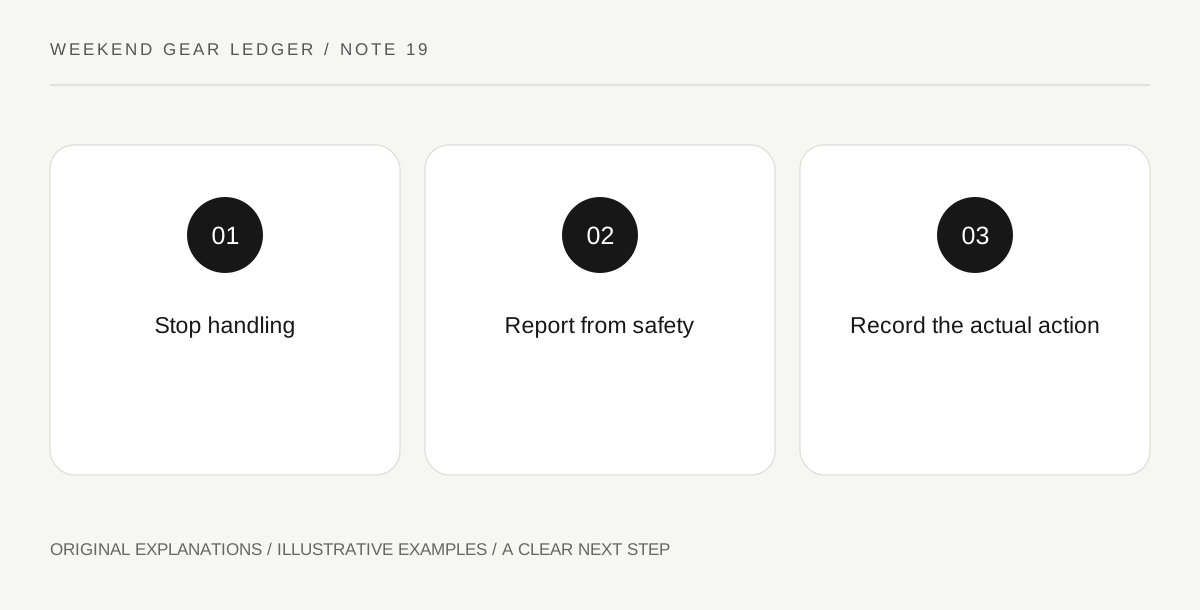
Original explanatory diagram. Read the full method and limitations below.
Learn the boundary from the briefing
NOAA advises leaving unknown items untouched and reporting potentially hazardous debris through appropriate authorities. Its examples include chemical containers and fuel-related objects. Ask your organizer who receives a participant’s report and how to reach them from the assigned area. Keep that contact method accessible. Do not wait until you are holding an object to ask whether it belongs in an ordinary collection bag.
Describe without investigating
If an unfamiliar item is found, stop handling and keep away. Report its visible appearance and location from a safe position according to the organizer’s procedure. Do not open, sniff, shake or move a container to identify its contents. A useful report can state that the item is unknown. Certainty is not required before declining to handle something that falls outside your training and the event’s ordinary task.
Keep the group response simple
Tell nearby participants and the designated leader what you have observed without drawing a crowd around the item. Follow their instructions and relevant local emergency procedures if there is immediate danger. Do not create an improvised barrier by moving the object or placing tools against it. Equipment intended for ordinary litter collection should remain within its defined use, rather than becoming a device for hazardous recovery.
Record the decision without claiming removal
If your event has a collection form, ask how an uncollected report is recorded. Do not count an item as safely removed when it was left for qualified handling. Afterward, review whether the reporting instructions were easy to access and pass that feedback to the organizer. The useful outcome is an understood responsibility boundary, not a photograph of a large or dramatic object in your bag.
Illustrative worked example
Illustrative example: A volunteer sees an unlabelled container near the group’s route. Instead of using a grabber to turn it over, the volunteer stops, keeps away and contacts the event leader with a location description. The leader follows the event’s reporting process. The volunteer log describes a reported unknown item, not a completed removal. No claim is made about what the container held or whether the fictional scene would be safe at a real site.
Questions that come up
Do thick gloves change the reporting boundary?
No. Do not treat ordinary protective equipment as authorization to handle an unknown or hazardous item. Follow the organizer’s task limits and appropriate official guidance rather than judging by whether you can physically grip it.
Must I identify the material before reporting it?
No. Give a clear location and visible description from a safe position, state uncertainty and use the designated channel. Investigation that requires touching or opening the object defeats the purpose of leaving it for qualified assessment.
References and scope
These sources support the factual background. Examples and exercises are original illustrative teaching material. References do not imply endorsement.
- NOAA: marine debris handling — Unknown and potentially hazardous items should not be touched or moved; report through appropriate local channels.