Read a Beginner Kite Package as a Complete Working Set
A low-priced kite can still be an incomplete purchase if the line, handle or instructions are missing. Before choosing a design, identify the entire set needed for the maker’s intended use. Then confirm a permitted place and suitable conditions; an appealing open patch on a map is only a starting question.
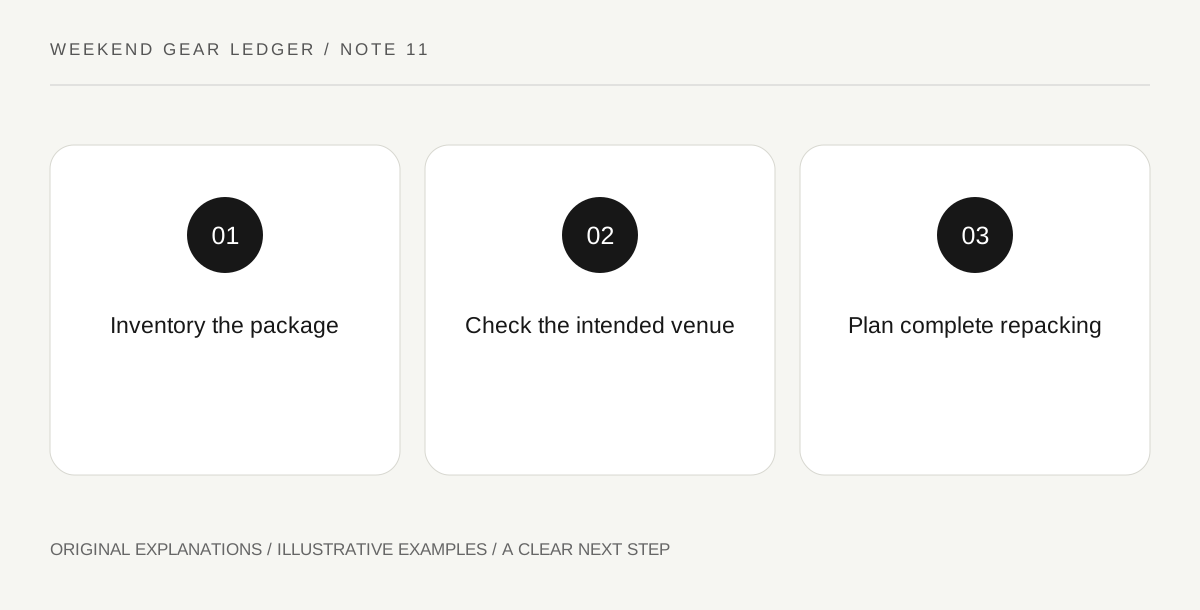
Original explanatory diagram. Read the full method and limitations below.
Inventory what the listing includes
Read the contents list rather than assuming the photographed accessories arrive with the kite. Record the kite type, included line and handle, assembly instructions and any separate components the maker requires. Keep single-line and more complex systems distinct. If a package is unclear, ask the seller for the exact contents. Avoid filling an information gap with improvised line or hardware from an unrelated household project.
Let location determine whether the plan works
The American Kitefliers Association advises avoiding power lines, wet or stormy weather, roads and conflicts with bystanders. Its guidance also emphasizes skill and equipment limits. Check local permissions and applicable airspace restrictions before choosing a site, and follow the manufacturer’s conditions. This article does not establish a safe distance for every location. If the intended place cannot meet the relevant requirements, choose another activity rather than a different colour kite.
Rehearse the packing sequence indoors
With the kite unlaunched, read the assembly and packing instructions and identify the named parts. Check how the supplied line and handle are stored so they do not become a loose tangle in transit. Do not test flight inside a confined room. If assembly requires force or a missing part, resolve that through the maker’s guidance before travelling. A completed shopping basket is not evidence that the set is usable.
Include the end of the session
Plan how every component and any packaging will come home. A compact sleeve is useful only if the assembled kite can be returned to its intended packed form without hurried bending. Check that nothing small is left on the ground and that loose line is contained. If a kite becomes entangled with dangerous infrastructure, do not attempt retrieval; keep away and contact the responsible service for guidance.
Illustrative worked example
Illustrative example: Sam finds an inexpensive kite listing that shows a handle in one image but does not name it in the contents. A seller reply confirms that the line set is separate. Sam compares the complete cost with another fully specified package, then checks a local organized kite session’s equipment advice. The purchase decision now includes both completeness and a realistic place to use it, without asserting that either model has been flight tested.
Questions that come up
Can I substitute any string I already own?
Do not improvise a line system. Use the equipment specified by the kite maker and seek assistance if the required set is unclear. Appearance alone does not establish strength, compatibility or safe handling.
Does a large open field guarantee suitability?
No. Permissions, airspace, power lines, roads, wildlife, weather and other people still matter. Use current local guidance and an appropriately organized beginner setting when you lack experience evaluating the conditions.
References and scope
These sources support the factual background. Examples and exercises are original illustrative teaching material. References do not imply endorsement.
- American Kitefliers Association: kite safety — Keep kite lines away from power lines, bystanders, roads and wet or stormy weather; respect skill and equipment limits.