Build a Quiet Lighting Setup for a Beginner Stargazing Evening
The light you bring to a stargazing gathering affects your neighbours as well as your own view. A useful setup starts with controllable brightness and a considerate routine. Rehearse its controls before darkness, and keep navigation needs distinct from reading a chart at the observing position.
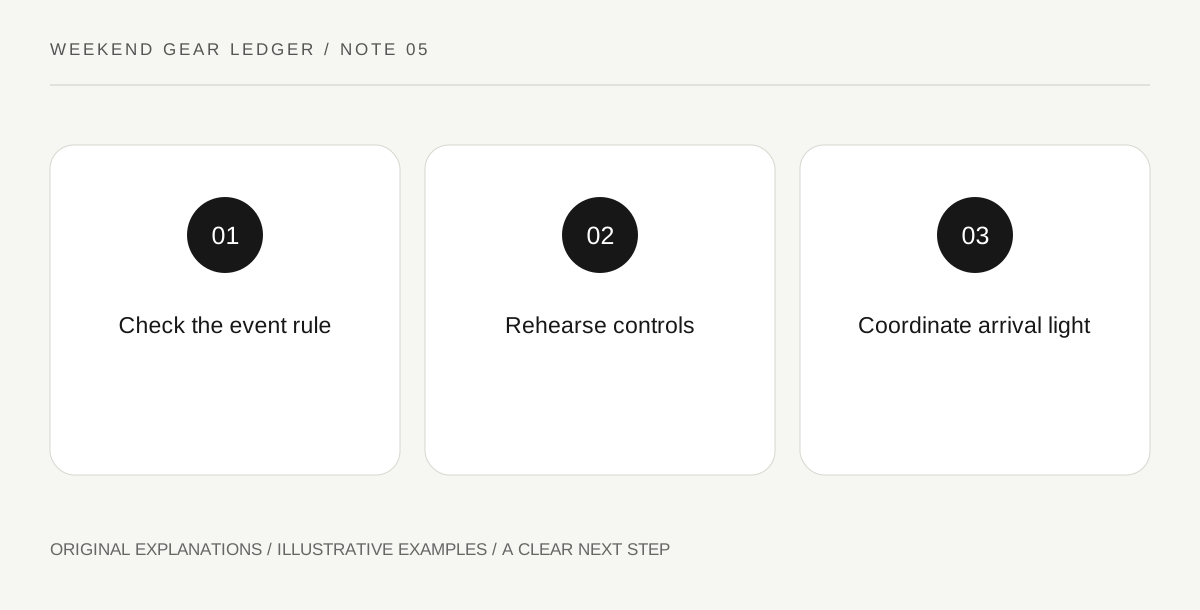
Original explanatory diagram. Read the full method and limitations below.
Understand why the organizer asks for red light
NASA’s beginner skywatching guidance discusses red lighting to help preserve dark adaptation. That does not make every red lamp unobtrusive or every brightness appropriate. Ask the event organizer what they allow, then inspect your existing equipment for an appropriate mode. Avoid buying an intense light simply because its packaging includes an astronomy theme. Control of direction and brightness matters to the group experience.
Learn the switch sequence in daylight
Cycle through the actual lamp controls where you can see them clearly. Some devices pass through a bright white mode before reaching another setting. Find out how yours starts after being switched off, whether it remembers a mode, and how an accidental press is prevented. Follow the manual; do not improvise electrical modifications or cover a lamp in material that its manufacturer has not approved.
Give screens their own rehearsal
Open the chart or event information you intend to use and examine the screen settings available on your device. Dim it appropriately before entering the observing area, and avoid aiming it toward other people. A dark interface is not permission to ignore event rules. Prepare essential arrival details ahead of time so you do not need to browse a collection of bright pages while others are observing.
Separate seeing the path from reading the chart
Ask where and how the group wants arrivals to use lights. An observing routine must still accommodate safe movement on the permitted route. If the route requires lighting inconsistent with an observing rule, seek organizer guidance rather than moving blindly. Keep the chart-reading position settled and the return arrangement simple. A modest local gathering can be a complete first equipment trial without travelling to a remote site.
Illustrative worked example
Illustrative example: A beginner checks an existing lamp and discovers that holding one button enters a low red setting directly, as described in its manual. They practise that sequence at home and save the organizer’s arrival instructions. At the gathering they ask before entering the viewing area and point the light only where needed. The useful result is an understood routine, not a claim about a measured improvement in vision.
Questions that come up
Is a red phone screen enough for every event?
No. Screen behaviour, brightness and local rules vary. Ask the organizer and test your actual device settings beforehand. Treat an astronomy label or colour filter as a feature to evaluate, not automatic permission.
Should I avoid all light while walking?
Do not sacrifice safe movement to preserve an observing view. Use the permitted route and appropriate lighting, and ask staff how to enter and leave without disrupting the group. Stop if the route cannot be used safely.
References and scope
These sources support the factual background. Examples and exercises are original illustrative teaching material. References do not imply endorsement.
- NASA: Stargazing for Beginners — Star maps and restrained red lighting for dark adaptation; no live sky schedule.